
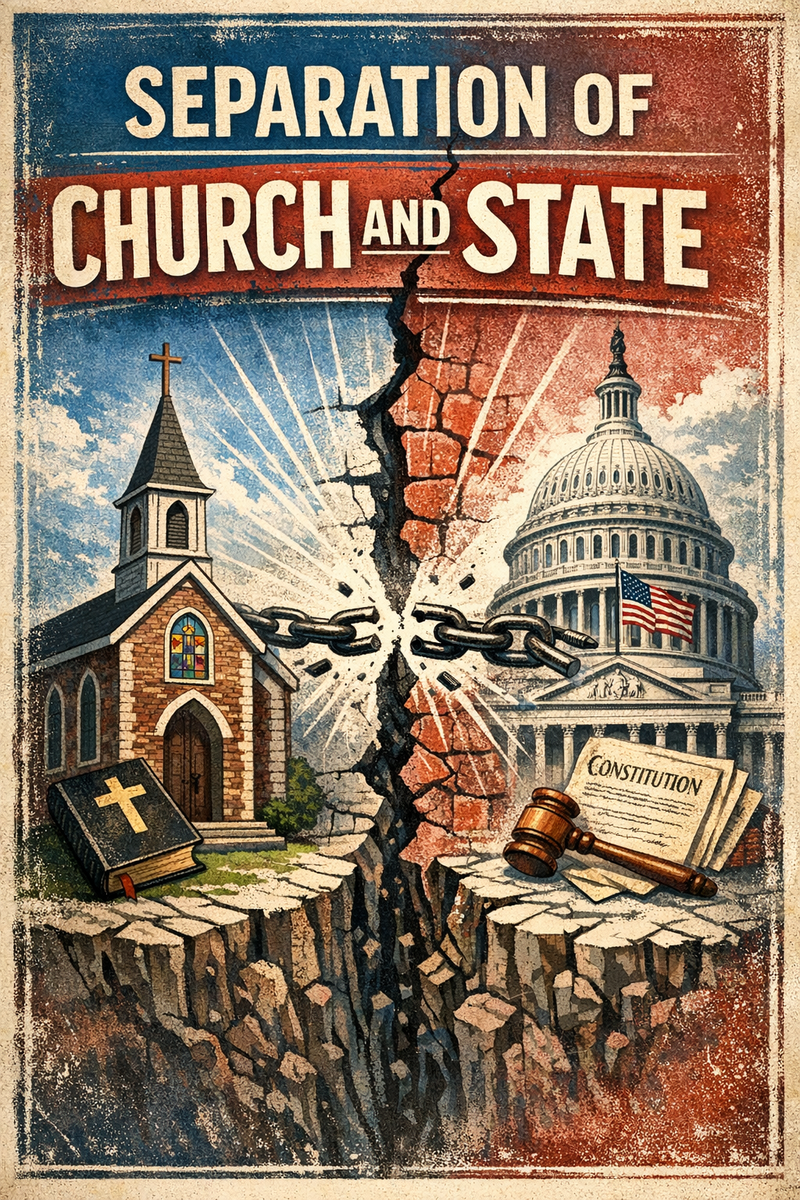
Separation of Church and State
Many people today refer to the phrase “Separation of Church and State,” yet few know where it actually comes from. Although widely quoted, this phrase does not appear in the Declaration of Independence, the Constitution, or the Bill of Rights.
In discussions about religion in public life, some claim “freedom from religion,” or argue that displaying a Bible, the Ten Commandments, or Scripture in a public setting violates this idea. But to understand the phrase correctly, we must look at its historical origin.
Where the Phrase Came From
The phrase first appeared in 1801 in a letter written by Thomas Jefferson to the Danbury Baptist Association of Connecticut.
Before this, Jefferson had worked to end the government‑run Anglican Church in Virginia, ensuring that no denomination would be controlled by the state. This allowed all believers—regardless of denomination—to practice their faith freely.
When Jefferson became President, the Danbury Baptists wrote to him expressing concern that the federal government might attempt to regulate religious practice. Jefferson responded by assuring them that the First Amendment created a “wall of separation between Church and State”—meaning the government could not interfere with religious expression.
The First Amendment
Jefferson’s reassurance was rooted in the actual text of the First Amendment:
“Congress shall make no law respecting an establishment of religion, or prohibiting the free exercise thereof…”
This means:
-
The government cannot establish a national or state church.
-
The government cannot restrict the free exercise of religion.
The amendment limits government, not the people. It protects individuals and churches from government control—not the other way around.
Why This Protection Exists
Many early settlers came to America seeking freedom from the government‑controlled Church of England. When forming a new nation, they wanted to ensure that no government would ever again dictate religious belief or practice. This conviction became part of the Constitution through the First Amendment.
Understanding the Phrase Today
So when someone uses the phrase “separation of Church and State” to discourage religious expression, it’s helpful to remember the historical truth:
-
The phrase is not found in any founding document.
-
Its original purpose was to protect religious freedom, not restrict it.
-
Americans are free to practice their faith without government interference.
